.svg)


%201.svg)
Key Takeaways
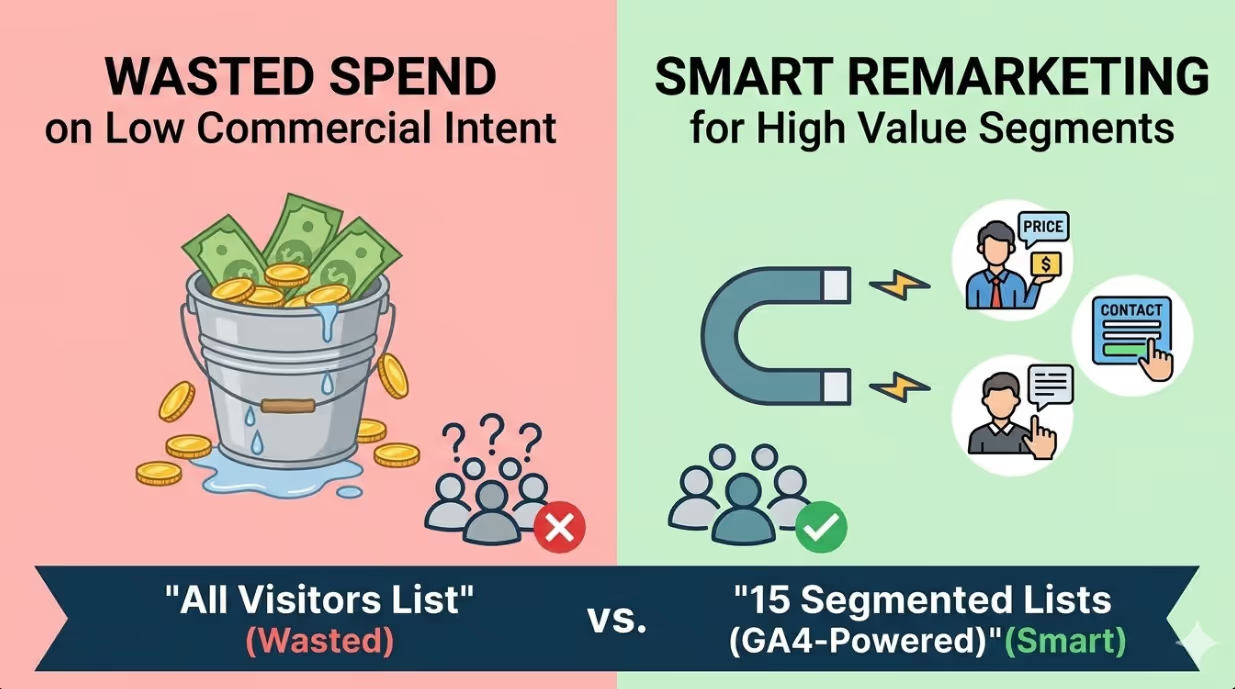
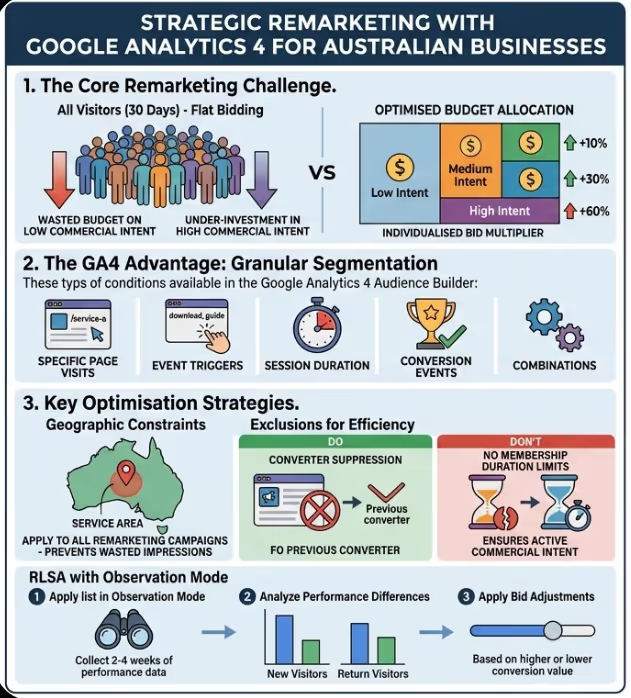
- A remarketing list covering all visitors applies identical bidding and messaging to audiences with fundamentally different commercial intent, wasting budget on segments with low commercial value and under-investing in segments with high commercial value.
- Google Analytics 4 audience builder allows Australian businesses to create remarketing lists based on specific page visits, event triggers, session duration, conversion events, and combinations of these conditions, providing granular segmentation capability beyond what the Google Ads native audience tool offers.
- Bid adjustments applied to remarketing lists in Search campaigns (RLSA) allow Australian businesses to increase bids for visitors with strong intent without creating separate campaigns, making the same search ad more competitive for the most valuable audience segments.
- Exclusions based on duration are as important as inclusions based on duration. Remarketing audiences should have membership duration limits that exclude visitors whose session was too long ago to represent active commercial intent.
- Converter suppression, removing people who have already converted from the active remarketing pools, prevents wasted spend on audiences who have already completed the desired action and whose reengagement should be handled through a separate, appropriate message.
- Geographic constraints specific to the service area should be applied to all remarketing campaigns to prevent wasted impressions from visitors outside the service area who may have found the site through organic search but represent no commercial opportunity.
- The fifteen lists described in this article represent distinct audience segments with different commercial profiles. They should be activated with different bid multipliers, different ad copy, and in some cases different offers rather than being shown the same remarketing creative used for the baseline list covering all visitors.
Building the Lists in Google Analytics 4
Each of the fifteen lists described in this article is built as an audience in Google Analytics 4 and then shared to the linked Google Ads account. The audiences are built in GA4 under Configure → Audiences → New audience, using the condition builder to define the specific behaviour, page visit, or event combination that defines each segment.
Once published to Google Ads, the audiences appear in the Audience Manager under Shared Library, where they can be applied to campaigns as observation audiences (to collect performance data without restricting the campaign's reach) or as targeting audiences (to restrict the campaign to only showing to that audience).
For Australian businesses using RLSA (Remarketing Lists for Search Ads), observation mode is the appropriate starting configuration: apply the audience to the existing search campaigns as observation, collect two to four weeks of performance data to see how these visitors perform relative to new visitors, and then apply bid adjustments based on the performance differences observed.
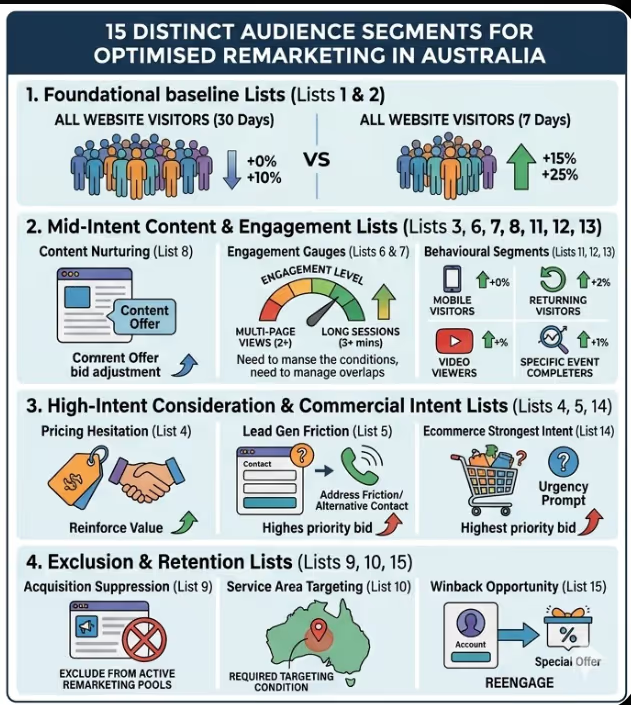
The 15 Lists
List 1: All Website Visitors (30 Days)
The foundational list. All sessions from any page, with a 30-day membership duration. This is the baseline audience that provides the broadest reach for awareness-level remarketing and provides the control group against which all other lists' performance can be benchmarked.
Recommended use: Low-bid Display remarketing for brand awareness. Bid adjustment of +0% to +10% in Search campaigns relative to the baseline.
List 2: All Website Visitors (7 Days)
The same audience covering all visitors with a 7-day membership window. Visitors who have been to the site in the last seven days are more likely to be in an active research or purchase phase than visitors from 30 days ago. Separating this segment allows a higher bid to be applied to the more recent and typically more commercially active cohort.
Recommended use: Display and Search remarketing at a moderate bid level. Bid adjustment of +15% to +25% in Search campaigns.
List 3: Service Page Visitors (30 Days)
Visitors who have viewed any primary service or product page on the site, excluding the homepage and general information pages. These visitors have expressed specific interest in what the business offers rather than just landing on the site generally.
Recommended use: Targeted Display remarketing with messaging specific to the service. Bid adjustment of +20% to +30% in Search campaigns.
List 4: Pricing or Quote Page Visitors (14 Days)
Visitors who have viewed the pricing page, quote request page, or any page that presents the business's fee structure or offer. These visitors have expressed commercial intent beyond general interest: they are evaluating whether the price is appropriate for their situation.
Recommended use: High priority remarketing with messaging that addresses the most common pricing hesitation or reinforces value. Bid adjustment of +40% to +60% in Search campaigns.
List 5: Contact Page Visitors Who Did Not Convert (14 Days)
Visitors who navigated to the contact page or enquiry form but did not submit the form. This is a segment with strong intent that encountered a friction point before converting. The reason the visitor did not convert may be the form, a distraction, or hesitation, and a remarketing message that addresses this directly (a different contact method, a offer with a lower commitment level, or a message that builds trust) can recover a proportion of these visitors.
Recommended use: High priority Search and Display remarketing with a specific message acknowledging the brand and offering an alternative path to contact. Bid adjustment of +50% to +70% in Search campaigns.
List 6: High Engagement Visitors (2 or More Pages, 14 Days)
Visitors who viewed two or more pages during their session. Visitors who viewed multiple pages have demonstrated a level of engagement that bounce visitors have not, indicating greater interest in the content and services. This list is defined in GA4 using the session condition for pages per session greater than or equal to two.
Recommended use: Remarketing with a bid priority between moderate and high. Bid adjustment of +25% to +35% in Search campaigns.
List 7: Long Session Visitors (3 or More Minutes, 14 Days)
Visitors who spent three or more minutes on the site during a session. Session duration is a useful proxy for engagement quality in categories where visitors who are genuinely interested spend meaningful time evaluating the content. This list uses the session duration condition in GA4 to isolate visitors with high engagement by time spent.
Recommended use: Remarketing at moderate to high priority. Often overlaps significantly with List 6, which should be reflected in audience configuration to avoid counting visitors twice in reporting.
List 8: Blog or Resource Readers (30 Days)
Visitors who have viewed a blog article, guide, or other informational resource. These visitors are typically earlier in the decision journey than those who visited service or pricing pages, and their remarketing message should reflect this: offer deeper educational content, a guide download, or a introduction to the business that requires lower commitment rather than a direct enquiry call to action.
Recommended use: Display remarketing with lower bids and messaging focused on content, oriented toward nurturing rather than immediate conversion. Bid adjustment of +10% to +15% in Search campaigns.
List 9: Converters (90 Days)
Visitors who have completed the primary conversion action on the site (submitted an enquiry form, made a purchase, booked an appointment). This list's primary function is exclusion: converter suppression prevents remarketing spend being wasted on audiences who have already taken the desired action. For service businesses with repeat purchase potential, converters can also be activated for a specific remarketing message sent after conversion after an appropriate delay.
Recommended use: Exclude from all active remarketing pools to prevent showing acquisition messaging to existing customers. Optionally activate as a separate audience of converters to be contacted after conversion with a specific reengagement or upsell message after 30 to 90 days.
List 10: Local Service Area Visitors (90 Days)
Visitors whose session originated from the business's primary service area geographic location. For local service businesses, traffic from outside the service area may represent a meaningful proportion of organic visitors who found the site through queries without geographic terms. Activating an audience limited to the service area ensures that the remarketing budget is spent on the segment most likely to represent genuine commercial opportunity.
Recommended use: Apply as a required condition (targeting, not observation) on all Search and Display remarketing campaigns for businesses serving a specific geographic market.
List 11: Mobile Visitors (14 Days)
Visitors who accessed the site on a mobile device. Mobile conversion rates and paths often differ from desktop, and for Australian service businesses in categories with high mobile usage (trades, healthcare, local services), mobile visitors may represent a different commercial intent profile from desktop visitors. Segmenting this audience allows separate ad formats specific to mobile and messages to be applied.
Recommended use: Observe initially to assess whether mobile visitors convert at a materially different rate than desktop visitors in the account. Apply a positive or negative bid adjustment based on the observed performance difference.
List 12: Video Viewers or Specific Event Completers
Visitors who completed a specific engagement event on the site, such as watching a video beyond 50 percent of its duration, downloading a document, using a calculator or interactive tool, or clicking a phone number. These event completions indicate a depth of engagement beyond page viewing that correlates with higher purchase intent in many categories.
Recommended use: High priority remarketing for the most conversion-relevant events (video views of a service explainer, calculator tool completers). Bid adjustment of +30% to +50% in Search campaigns.
List 13: Returning Visitors (Any Period)
Visitors who have made two or more sessions to the site, regardless of which pages they visited. Return visitors have demonstrated sustained interest over time. In competitive service categories, a visitor who returns to the site independently is at a meaningfully different purchase readiness level than a first-time visitor.
Recommended use: Remarketing at moderate to high priority. Bid adjustment of +20% to +30% in Search campaigns.
List 14: Abandoned Cart or Checkout Visitors (7 Days) — Ecommerce
For Australian ecommerce businesses, visitors who added a product to cart or began the checkout process without completing a purchase are the audience with the strongest intent in the entire remarketing structure. This audience segment is defined by the add to cart or begin checkout event in GA4 combined with the absence of a purchase completion event.
Recommended use: Highest priority remarketing for ecommerce, with direct messaging specific to the product, a reminder of cart contents where technically possible, and a urgency prompt with a time limit. Bid adjustment of +70% to +100% in Search campaigns.
List 15: Lapsed Customers (91 to 365 Days)
For businesses where repeat purchasing is commercially important, previous customers who have not visited or purchased within the last 91 to 180 days represent a winback opportunity distinct from both active customers and cold prospects. This list uses a GA4 condition combining a conversion event older than 90 days with no recent session.
Recommended use: Separate winback campaign with a specific reengagement message, potentially including a return incentive, distinct from the active acquisition and remarketing campaigns.
Structuring the Bid Adjustments and Exclusions
Once the fifteen lists are built and shared to Google Ads, the structural application requires two types of configuration:
Bid adjustments. For each remarketing list applied to Search campaigns, a bid adjustment that reflects the higher or lower commercial value of that audience relative to new visitors. A pricing page visitor from the last 14 days is worth a materially higher bid on the same keyword than an unknown new visitor, because the conversion probability is higher. Setting bid adjustments of +40% to +60% for the lists with high intent and reducing bids for segments with lower intent optimises the budget allocation across the audience spectrum.
Exclusions. Converters should be excluded from all campaigns focused on acquisition to prevent showing acquisition messaging to existing customers. Lists covering all visitors with very recent membership (1 to 2 days) can optionally be excluded from Display campaigns where very new visitors might be annoyed rather than reminded by immediate remarketing. And visitors whose sessions were very short (under 10 seconds) can be excluded to remove likely bot traffic or accidental clicks from the remarketing pools.
FAQs
How much traffic does an Australian business need before PPC remarketing becomes worth activating?
Remarketing audiences must reach a minimum size before Google Ads will serve ads to them: 1,000 active users for Display remarketing and 1,000 members for Search remarketing (RLSA). An Australian business that generates fewer than 1,000 website visitors per month will find that most of the fifteen lists, particularly the narrow, ones with the strongest intent, do not reach the minimum size threshold and therefore cannot be activated. For businesses at this traffic level, the practical starting point is consolidating into three to five of the lists with the highest priority rather than attempting to activate all fifteen, ensuring at least the lists with strong intent (pricing page visitors, contact page visitors who did not convert) reach the minimum threshold by expanding the membership window to 30 or 60 days. Businesses generating 3,000 or more monthly visitors can typically activate the full list structure within four to six weeks of implementation.
Should Australian businesses use the same ad creative for all remarketing lists, or create separate ads for each segment?
The commercial value of segmented audiences is significantly diminished if all segments receive the same ad creative, because the message that is most relevant to a pricing page visitor is fundamentally different from the message most relevant to a blog reader or a lapsed customer. At a minimum, Australian businesses should create three creative variants: a message for lists with high intent 4, 5, 12, and 14 that reinforces decision factors and includes a direct call to action; a message for lists at a medium intent level 3, 6, 7, and 13 that builds credibility and presents a next step requiring minimal friction; and a nurture message for lists 8, 1, and 2 that provides content that leads with value and a soft introduction to the business's services. For ecommerce businesses, list 14 (abandoned cart) should always have its own creative specific to the product. Investing in differentiated creative across these three tiers typically produces a 30 to 50 percent improvement in remarketing conversion rate relative to a single undifferentiated message.
How often should Australian businesses review and update their remarketing audience lists?
The audience configurations should be reviewed quarterly to assess whether the defined conditions still align with the website's structure and the business's commercial goals. Website changes, including URL changes to key pages, new service offerings, revised conversion events, or significant changes in the customer journey, require the corresponding audience definitions to be updated so they still capture the intended segment. The performance of each list, measured by conversion rate relative to the baseline list of all visitors and the cost per conversion relative to cold traffic, should be reviewed monthly to identify which lists are delivering commercial return and which need adjustments to their bid multipliers, membership duration, or ad creative. Lists that consistently underperform new visitor benchmarks, particularly after creative and bid adjustments have been attempted, may be candidates for consolidation with related lists to increase segment size and improve statistical reliability.
The Right Audience Receives the Right Message at the Right Bid
The fifteen remarketing lists in this article represent the full spectrum of commercial intent that an Australian business's website audience contains, from the visitor who is on the verge of converting to the one who stumbled across the site months ago and has no active interest. Treating all of these audiences the same way is one of the most common and most costly inefficiencies in Australian PPC management. Segmenting them correctly, bidding appropriately to each segment's commercial value, and matching the message to the intent level of each audience is the practice that transforms remarketing from a background activity into one of the channels with the highest return in the paid media programme.
Maven Marketing Co builds and manages PPC remarketing audience structures for Australian businesses, including GA4 audience configuration, Google Ads integration, bid strategy, and creative development across segmented audience tiers.
Talk to the team at Maven Marketing Co →

Table of contents
read more blogs
Is Google Ads Better Than SEO for My Business
One of the biggest questions business owners ask when they are planning online growth is whether they should invest in Google Ads or SEO. Both are strong marketing plays that help your company show up in Google search results, but they do things in separate lanes. Google Ads gives quicker visibility and can bring in leads fast, whereas SEO more or less focuses on slow, steady organic traffic that tends to grow the longer you keep building it. Picking the right direction depends on what you want to achieve, how much money you can spend, how crowded the market is, and how quickly you need results, like sooner rather than later. The good news is you don’t always have to choose one or the other; it’s not exactly a black-and-white situation. If you take time to understand the strongest points of both, you can put together a more sensible digital marketing plan that supports consistent expansion. In this guide, we’ll compare Google Ads vs SEO, explain the main differences, and help you figure out what option makes the most sense for your business.

When Should I Hire a Digital Marketing Agency
Growing a business today takes more than just having a website or throwing a post on social media; customers usually search around online, compare providers, skim reviews, and basically expect the brand to show up with a solid digital presence before they even think about buying. Many businesses try to run their marketing themselves, but there comes a point when “doing it all in-house” becomes clunky and hard to manage, all at once. Knowing when to hire a digital marketing agency can end up making a big, real difference for your growth. If you’re not getting enough leads, or your online visibility feels stuck, or sales are just not moving, the right agency can bring the know-how, plus a clear plan, to help you get noticeably better outcomes. In this guide, we’ll dig into what a digital marketing agency actually does, the usual signs it’s time to bring one on, and how picking the right marketing partner can help your business move forward at a faster pace.
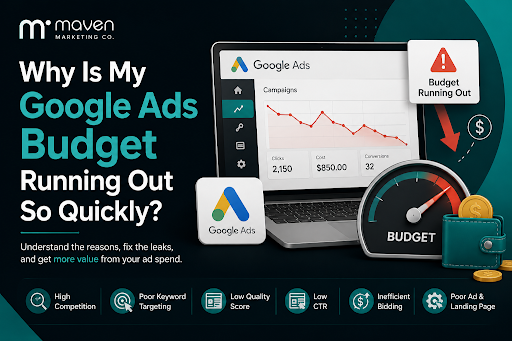
Why Is My Google Ads Budget Running Out So Quickly
Running a successful Google Ads budget isn’t only about throwing more money at it. It’s more like making every dollar, doing a bit extra. A lot of businesses start a Google Ads campaign with big hopes, then find out their daily budget is gone within a few hours, and that feels weird, right? After that, your ads stop showing effectively, new leads slip away, and your return on investment dips. So if your Google Ads budget is running out too fast, don’t stress. It’s a fairly common issue, and in most situations, it can be repaired with the right approach. There are multiple little things that can drain your advertising money quicker than you expected, from costly keywords to audience targeting that just doesn’t quite fit. In this guide, we’ll walk through why your budget disappears so quickly, how to cut wasteful spend, and the most reliable ways to boost your Google Ads ROI, even if your budget stays the same.