.svg)


%201.svg)
.avif)
Key Takeaways
- Custom WordPress development becomes necessary when business requirements exceed premade theme capabilities, including unique functionality, brand differentiation, performance optimization, or integration complexity
- Off-the-shelf themes cost $50-$200 but require compromises on design, features, and performance, while custom development costs $10,000-$100,000+ but delivers precisely matched business solutions
- Performance advantages of custom development include 40-60% faster load times through eliminating unused code, optimized database queries, and purposeful architecture versus bloated multipurpose themes
- Custom solutions provide competitive differentiation through unique user experiences, proprietary features, and brand-aligned design impossible to achieve with themes used by thousands of other businesses
- Strategic custom development investment pays long-term returns through reduced maintenance costs, eliminated licensing fees, future-proof scalability, and aligned functionality supporting business growth
A Melbourne manufacturing company launched with premium multipurpose theme costing $89. Initially, the theme's flexibility seemed perfect—hundreds of pre-built layouts, extensive customization options, and impressive demo sites. Two years later, they struggled with slow page loads from unused theme features, design constraints preventing brand expression, and workarounds jury-rigging custom functionality the theme wasn't designed to handle.
After investing $45,000 in custom WordPress development, they achieved 2.5-second page loads versus previous 8-second loads, distinctive brand identity differentiating from competitors, streamlined admin workflows matching their processes, and proprietary product configurator impossible with premade themes. The performance improvements alone increased conversions by 34%, paying for development within 14 months.
This illustrates the fundamental tension: premade themes offer speed and affordability but impose limitations, while custom development requires significant investment but removes constraints. The decision isn't about which approach is "better" universally—it's about which aligns with specific business needs, growth trajectory, and competitive positioning.
According to research from WP Engine, 43% of businesses eventually outgrow premade themes and require custom development, while 23% report premade theme limitations directly impacted business growth. Understanding when this transition makes strategic sense prevents costly premade investments that require eventual replacement.
.avif)
Understanding Off-the-Shelf Theme Limitations
Premade WordPress themes serve many businesses effectively, but understanding their inherent limitations reveals when custom development becomes necessary rather than optional.
Design constraints limit brand expression within theme structures. Themes provide customization options (colours, fonts, layouts), but fundamental design architecture remains fixed. Visual identity requiring unique layouts, unconventional content structures, or distinctive interface patterns exceeds customization capabilities. Businesses needing strong brand differentiation struggle within theme constraints that produce similar-looking websites across thousands of users.
Feature bloat degrades performance as multipurpose themes include functionality for diverse use cases, most irrelevant to individual businesses. E-commerce features sit unused on service business sites. Multiple slider options load when only one is needed. Extensive shortcode libraries consume resources despite limited usage. Research from Kinsta shows multipurpose themes average 2-4MB versus 500KB-1MB for custom themes, directly impacting load times and mobile performance.
Code quality variations affect security, performance, and maintainability. Premium themes from established developers generally maintain quality standards, but marketplace themes vary dramatically. Inefficient database queries, security vulnerabilities, poor coding practices, and lack of WordPress coding standards create technical debt. Businesses lack visibility into theme code quality until problems emerge.
Update dependencies create ongoing maintenance challenges. Theme updates sometimes break customizations, require testing before applying, conflict with plugins creating compatibility issues, or change functionality unexpectedly. Businesses become dependent on theme developers for updates, security patches, and compatibility maintenance. If developers abandon themes, businesses face security risks from un-updated code.
Customization limitations force workarounds when business needs diverge from theme capabilities. Child themes override parent theme templates, but major structural changes prove difficult or impossible. CSS customization reaches limits when layout changes require template modifications. Plugin additions work around theme limitations, creating plugin bloat and potential conflicts. Eventually businesses accumulate technical debt from workarounds rather than purposeful solutions.
Lock-in effects make switching themes painful after content investment. Switching themes often requires content reformatting, shortcode replacement (theme-specific shortcodes break on theme changes), widget reconfiguration, and extensive testing. The switching cost increases over time as content accumulates, effectively locking businesses into theme choices made years earlier under different circumstances.
Support limitations vary by theme provider. Some offer excellent support; others provide minimal assistance. Support forums help common issues but struggle with unique business requirements. Customization requests often exceed support scope, requiring developer hiring anyway. Businesses expecting comprehensive support from $60 theme purchases frequently discover limitations.
Mobile optimization gaps affect user experience despite responsive claims. Themes technically responsive might provide poor mobile UX through cluttered mobile layouts, slow mobile loading from desktop-equivalent resources, or touch-unfriendly interfaces. True mobile optimization requires mobile-first design thinking, not just responsive scaling of desktop designs.
When Custom WordPress Development Makes Strategic Sense
Certain business situations, growth stages, and requirements clearly justify custom development investment over premade theme limitations.
Unique business models require functionality premade themes don't address. Subscription businesses with complex pricing tiers, marketplace platforms connecting buyers and sellers, booking systems with specialized availability logic, or configurators for customized products need purpose-built solutions. While plugins extend WordPress functionality, complex business models often require integrated custom development.
Competitive differentiation through digital experience justifies custom development for businesses where website represents primary competitive advantage. E-commerce brands where user experience drives conversion, SaaS companies where product trial and signup flow impact customer acquisition, or service businesses where website directly influences lead quality benefit from differentiated digital experiences impossible with themes used by competitors.
Performance requirements for high-traffic sites or conversion-critical pages warrant custom development optimization. Sites receiving 100,000+ monthly visitors benefit from performance optimization eliminating theme bloat. Conversion-focused landing pages justify custom development removing every unnecessary byte. Mobile-first businesses serving predominantly mobile audiences need mobile-optimized architecture, not responsive desktop themes.
Brand investment at enterprise scale expects matching digital presence. Established brands with significant brand equity require websites reflecting brand value rather than template limitations. Custom development enables precise brand expression through typography, colour usage, spacing, and visual hierarchy impossible within theme constraints.
Complex integrations with CRM systems, ERPs, inventory management, or proprietary databases often exceed plugin capabilities. Custom development enables purpose-built integrations with existing business systems, optimized API implementations, secure data synchronization, and unified workflows. These integrations frequently represent competitive advantages premade solutions can't replicate.
Scalability planning for rapid growth or traffic spikes benefits from custom architecture designed for scale. Custom database optimization, efficient caching strategies, CDN integration, and performance-first code handle growth that breaks bloated themes. Businesses anticipating significant growth invest in scalable foundations rather than rebuilding later.
Proprietary features creating business value beyond websites justify custom development. Custom calculators, assessment tools, or interactive experiences that prospects value can't be replicated by competitors using same themes. These features represent intellectual property and competitive moats worth custom investment.
Long-term cost optimization sometimes favours upfront custom development over ongoing theme costs. Eliminating premium theme license renewals, reducing plugin subscriptions (custom features replace paid plugins), and decreasing developer time debugging theme limitations can create favourable long-term economics despite higher initial investment.
Team workflow optimization through custom admin interfaces improves operational efficiency. Custom meta boxes for content entry, simplified publishing workflows, role-specific admin experiences, or integration with existing tools reduce training time and increase productivity. These workflow improvements justify custom development for content-heavy organizations.
.avif)
Custom Development Process and Timeline Expectations
Understanding custom WordPress development process helps Australian businesses set realistic expectations and plan appropriately.
Discovery and requirements phase (2-4 weeks) defines project scope through stakeholder interviews understanding business objectives and requirements, competitor analysis identifying differentiation opportunities, user research revealing target audience needs and behaviors, technical requirements documenting integrations and functionality, and content strategy planning structure and information architecture. Thorough discovery prevents scope creep and ensures development aligns with business needs.
Design phase (3-6 weeks) creates visual direction through wireframing showing layouts and information hierarchy, visual design establishing brand expression and aesthetics, responsive design planning mobile, tablet, and desktop experiences, and interactive prototyping demonstrating complex interactions. Design review cycles incorporate stakeholder feedback before development begins. According to Toptal's development research, investing adequate time in design (20-25% of total project) reduces development rework and improves outcomes.
Development phase (6-12+ weeks) builds functional website through front-end development implementing designs in HTML/CSS/JavaScript, WordPress theme development creating custom theme architecture, custom functionality development for unique features, third-party integrations connecting external systems, and content migration transferring existing content if applicable. Development duration varies significantly by complexity—simple custom themes complete faster than complex applications.
Quality assurance phase (2-3 weeks) validates functionality through cross-browser testing on major browsers and versions, device testing across phones, tablets, and desktops, performance testing measuring load times and optimization, security testing identifying vulnerabilities, accessibility testing ensuring WCAG compliance, and user acceptance testing with stakeholders. Identifying issues before launch prevents embarrassing post-launch discoveries.
Launch and deployment (1 week) transitions to production through staging environment testing replicating production conditions, DNS configuration and domain management, production deployment and final checks, training for content editors and administrators, and launch monitoring watching for unexpected issues. Careful launch planning minimizes downtime and transition friction.
Post-launch support (ongoing) maintains site health through bug fixes addressing post-launch discoveries, performance monitoring and optimization, security updates and patches, content support for ongoing updates, and feature enhancements as business needs evolve. Maintenance contracts ensure long-term site health and developer familiarity.
Total timeline expectations range 3-6 months for straightforward custom themes to 6-12+ months for complex applications with extensive functionality. Rushing development compromises quality. Australian businesses should plan realistic timelines accommodating thorough work rather than arbitrary deadlines forcing compromises.
.avif)
Cost Considerations and Budget Planning
Custom WordPress development represents significant investment requiring strategic budget planning and realistic cost expectations.
Premade theme costs (baseline comparison) include theme purchase ($50-$200 one-time or annual), premium plugins ($100-$500 annually), customization developer time ($1,000-$5,000), and hosting suitable for theme requirements ($200-$1,000 annually). Total first-year costs range $1,500-$7,000, with ongoing annual costs of $300-$1,500. However, this excludes opportunity costs from limitations and potential revenue impact from poor performance or UX.
Custom development costs vary by project scope and complexity. Simple custom themes with standard functionality range $10,000-$25,000. Mid-complexity sites with custom features and integrations range $25,000-$75,000. Complex applications with extensive custom functionality range $75,000-$200,000+. Enterprise implementations can exceed $500,000 for large organizations with extensive requirements. Australian development rates typically range $100-$200 per hour for experienced WordPress developers.
Cost components breakdown includes discovery and strategy (10-15% of budget), design (20-25%), development (45-55%), quality assurance (5-10%), and project management (5-10%). Understanding component breakdown helps evaluate proposals and identify where costs concentrate.
Ongoing costs post-launch include hosting (typically higher performance requirements than shared hosting, $100-$500+ monthly), maintenance and support (10-20% of development cost annually), security monitoring and updates, content updates if not handled in-house, and feature enhancements or additions. Budget for ongoing costs prevents surprise expenses post-launch.
Hidden costs to consider include content creation if starting fresh, photography or video production, copywriting, training for staff, and opportunity costs during development (existing site limitations continue while new site builds). Comprehensive budgeting accounts for total project costs, not just development.
ROI calculation frameworks justify custom development through increased conversion rates (even 1-2% improvement on high-value conversions pays for development quickly), reduced bounce rates from better performance and UX, improved SEO from technical excellence and performance, operational efficiency from workflow optimization, and reduced long-term technical costs from eliminating workarounds and theme limitations.
Financing and payment structures typically follow milestone-based payments: discovery and strategy phase (20-25% upfront), design approval (25-30%), development milestones (30-40%), and launch and final payment (10-20%). This structure aligns payments with progress while protecting both parties.
Cost optimization strategies without compromising quality include phased development launching MVP (minimum viable product) then adding features iteratively, reusing open-source components where appropriate rather than building everything custom, prioritizing features by business value developing critical functionality first, and using offshore resources strategically for appropriate tasks while maintaining Australian project management and quality control.
.avif)
Finding and Evaluating Custom WordPress Developers
Selecting the right development partner critically impacts project success, making developer evaluation as important as project definition.
Developer categories serve different needs and budgets. Freelance developers offer lower costs and direct communication but limited capacity and potential continuity risks. Small agencies (3-10 people) balance affordability with team resources and accountability. Mid-size agencies (10-50) provide specialized roles and comprehensive services. Large agencies (50+) handle enterprise complexity but at premium pricing. Each suits different project scales and organizational preferences.
Australian versus offshore development presents trade-offs. Australian developers offer timezone alignment, cultural understanding, and easier communication but at higher hourly rates ($100-$200). Offshore developers (India, Eastern Europe, Philippines) provide lower rates ($25-$75) but timezone challenges, potential communication barriers, and variable quality. Many Australian businesses use hybrid approaches—Australian project management and strategy with offshore development resources.
Portfolio evaluation reveals developer capabilities through reviewing previous WordPress work, examining code quality if accessible (GitHub repositories), assessing design sophistication, and investigating site performance of portfolio pieces. Contact portfolio clients asking about experience, communication, and post-launch support quality.
Technical capability assessment examines WordPress core expertise understanding themes, plugins, and customization approaches, front-end skills in modern HTML/CSS/JavaScript frameworks, back-end PHP development proficiency, database optimization knowledge, security best practices implementation, performance optimization experience, and integration capabilities with third-party systems.
Process and methodology indicates project management maturity through discovery and planning approaches, communication frequency and methods, revision and feedback processes, quality assurance procedures, launch planning and support, and post-launch maintenance offerings. Developers with defined processes typically deliver better outcomes than ad-hoc approaches.
Red flags to avoid include unrealistic timelines or budgets (quality custom development takes time and costs appropriately), lack of WordPress-specific expertise (general web developers may lack WordPress best practices knowledge), poor communication or unresponsiveness during sales process (won't improve during project), no portfolio or references, unwillingness to discuss process or methodology, and pressure tactics or aggressive sales approaches.
Contracts and agreements should specify scope definition and change process, timeline with milestones, payment terms and schedule, intellectual property ownership (you should own final code), support and maintenance terms, confidentiality agreements if applicable, and termination clauses protecting both parties. Legal review of contracts protects significant investments.
Communication and collaboration expectations include regular status updates (weekly at minimum), responsive communication (responses within 1-2 business days), transparency about challenges or delays, and collaborative problem-solving when issues arise. Establish communication preferences and tools at project start.
.avif)
Maintaining and Evolving Custom WordPress Sites
Custom development requires ongoing maintenance, but provides better long-term sustainability than premade theme dependencies.
Security maintenance prevents vulnerabilities through WordPress core updates (minor updates automatic, major updates tested then applied), custom code security patches, dependency updates (libraries and frameworks), security monitoring for breach attempts, and regular security audits. Custom code requires active maintenance—unlike themes with developer-provided updates, custom sites need assigned responsibility for security.
Performance optimization maintains speed as content grows through database optimization and cleanup, image optimization and compression, caching strategy updates, CDN configuration maintenance, and code performance reviews. Monitor Core Web Vitals and performance metrics addressing degradation proactively.
Content updates and management empower teams through content editor training on custom admin interfaces, documentation for custom features and workflows, media management best practices, and SEO optimization guidance. Custom sites often provide streamlined content workflows improving productivity versus complex theme admin interfaces.
Feature evolution grows site with business through enhancement planning based on analytics and feedback, iterative development adding features without massive rebuilds, A/B testing custom elements optimizing conversion, and integration additions as business tools evolve. Custom architecture enables gradual evolution versus theme limitations requiring workarounds.
WordPress version compatibility requires planning through major version testing before upgrading, deprecated function updates in custom code, PHP version compatibility as server requirements increase, and proactive code modernization maintaining current practices. Custom code requires active version management.
Documentation importance enables transitions through code documentation explaining custom functionality, admin user guides for content management, developer documentation for future maintenance, and architecture documentation showing how systems connect. Proper documentation prevents knowledge loss when developers change.
Support and maintenance contracts ensure ongoing health through monthly retainers covering security updates, performance monitoring, content support, and minor updates. Typically 10-20% of original development cost annually. Many Australian businesses find maintenance contracts essential for custom sites versus do-it-yourself theme updates.
Long-term cost predictability provides budget visibility. Custom sites eliminate premium theme renewals, reduce plugin subscription needs (custom features replace some paid plugins), and prevent theme lock-in costs. While maintenance costs are ongoing, they're predictable and often less than accumulated theme/plugin costs over 5-10 years.
Frequently Asked Questions
At what point should Australian businesses transition from using premade WordPress themes to investing in custom development, and what warning signs indicate a business has outgrown its current theme?
Transition timing depends on business stage, growth trajectory, and strategic priorities rather than arbitrary thresholds. Clear indicators suggesting custom development consideration include performance degradation where site loads take 5+ seconds despite optimization efforts, theme bloat slowing pages with unused features, or mobile performance lagging desktop significantly. Premade themes' multipurpose nature creates inherent performance limitations that optimization can only partially address. Limitation frustrations when needed features require extensive workarounds, design constraints prevent brand expression, or admin workflows feel clumsy and inefficient signal theme limitations impacting business. Growth inflection points including 50,000+ monthly visitors (performance and scalability become critical), $1M+ annual revenue where website directly drives sales (small conversion improvements justify development investment), or entering new markets requiring functionality current theme can't support. Competitive pressure when competitors launch superior digital experiences, industry standards evolve beyond theme capabilities, or brand positioning requires differentiation impossible with popular themes. Integration needs connecting CRM, ERP, inventory, or proprietary systems exceed plugin capabilities, requiring purpose-built solutions. Team productivity issues where content teams struggle with theme admin complexity, custom content types don't fit theme structure, or workflow inefficiencies cost significant time. Calculate opportunity cost of theme limitations by estimating revenue impact of performance improvements (even 0.5-second load time improvement often increases conversion 5-10%), improved user experience, eliminated workarounds requiring developer time, and competitive disadvantage from inferior digital presence. If opportunity costs exceed $20,000-$50,000 annually, custom development investment likely pays for itself within 1-3 years. Research from Forrester shows that 1-second page load improvement can increase conversion rates 7%, revenue per visitor 2%, and customer satisfaction 16%—meaningful impacts for established businesses. Warning signs specifically indicating outgrown themes include regular developer time spent working around theme limitations, accumulating technical debt from workarounds and patches, theme updates breaking customizations requiring fixes, increasing plugin counts attempting to add needed functionality (10+ active plugins often indicates feature gaps), and strategic initiatives delayed by website limitations. Businesses should evaluate custom development when growth trajectory projects 3-5 year needs rather than current needs. Investing at $500K revenue anticipating $2M growth within 3 years makes more sense than waiting until $2M when website already constrains growth. However, premade themes suit many businesses indefinitely. Businesses with standard requirements, limited technical resources, modest traffic volumes, and commoditized offerings may never need custom development. Consulting with experienced WordPress developers provides objective assessment whether custom development creates sufficient value for specific situation versus premature investment.
What should Australian businesses expect to pay for custom WordPress development, and how can they determine whether quoted prices are reasonable versus overpriced or suspiciously cheap?
Custom WordPress development costs vary dramatically by project complexity, developer expertise, and feature requirements, making price ranges broad but understandable through component analysis. Simple custom themes with standard WordPress functionality (blog, basic pages, contact forms) range $10,000-$25,000 from Australian developers. These projects involve custom design, responsive development, basic SEO optimization, and training. Mid-complexity sites with custom post types, advanced custom fields, custom admin interfaces, and third-party integrations (payment gateways, CRM, email marketing) range $25,000-$75,000. These include significant custom functionality beyond template customization. Complex applications with extensive custom features, user account systems, complex workflows, proprietary functionality, and multiple integrations range $75,000-$200,000+. Enterprise WordPress implementations for large organizations with extensive requirements can exceed $500,000. These figures reflect Australian development rates ($100-$200+ hourly) and typical project timelines (3-6+ months). Offshore development costs 40-70% less but introduces communication, timezone, and quality management challenges. Evaluating quote reasonableness requires understanding component breakdown. Discovery and strategy should represent 10-15% of total budget—inadequate discovery leads to scope issues. Design should be 20-25%—less suggests insufficient design attention. Development typically consumes 45-55% representing largest investment. Quality assurance deserves 5-10% preventing expensive post-launch issues. Project management should account for 5-10% coordinating complex projects. Red flags in pricing include suspiciously low quotes (under $5,000 for supposedly custom development likely indicates offshore outsourcing, template customization misrepresented as custom, or inexperienced developers underpricing), vague scope without detailed breakdown (prevents accountability and enables scope disputes), hourly quotes without estimates (creates budget uncertainty—prefer fixed-price or capped hourly), or unwillingness to explain cost breakdown. Suspiciously high quotes (3-4x typical rates without clear justification) might indicate inefficiency, premium agency overhead, or simply testing budget limits. Get multiple quotes (3-5 developers/agencies) for comparison. Evaluate proposals beyond price including process clarity and timeline realism, portfolio relevance to your needs, communication quality during sales process, technical approach and architecture, and included support and training. Hourly rates alone don't determine value—experienced developers working efficiently at $150/hour often cost less than inexperienced developers at $75/hour taking twice as long. Calculate total project cost, not hourly rates. Require detailed proposals specifying included features and deliverables, excluded elements, assumption dependencies, revision allowances, and payment schedule. This enables apples-to-apples comparison. Ask specific questions about technical approaches including custom versus framework usage (frameworks accelerate development but may include unnecessary features), coding standards followed, security measures implemented, performance optimization approach, and backup and staging environments provided. Value-based pricing considers business impact rather than just development cost. If custom development will increase conversions generating additional $100,000 annual revenue, $50,000 investment creating 50% ROI within year seems reasonable regardless of hourly rate justification. Finally, cheaper isn't always better for custom development. Quality WordPress development requires expertise earned through years of experience. Extremely low quotes often result in poor code quality, security vulnerabilities, performance issues, or projects that exceed initial budgets through scope disputes. Budget appropriately for quality work rather than optimize solely for lowest cost.
How should Australian businesses manage the transition from an existing premade theme to custom WordPress development, and what strategies minimize disruption to ongoing business operations during the rebuild process?
Managing custom development transition requires careful planning minimizing business disruption while enabling thorough development. Optimal approach develops custom site completely separate from production site through staging environment independent of live site, allowing development without affecting current operations. Staging sites live on development servers or subdirectories, invisible to public but accessible to stakeholders for review. This separation enables content teams to maintain current site normally while development progresses. Content migration strategy determines how existing content transfers to custom site. Options include automated migration using export/import tools for standard content (posts, pages, basic custom fields), manual recreation for limited content benefiting from reorganization or quality improvement, or hybrid approaches migrating bulk content automatically while manually optimizing key pages. Plan content migration early identifying which content needs improvement versus straight transfer. Timeline coordination sequences development stages with business cycles. Avoid launching during peak business periods, major campaigns, or busy seasons when website issues would be most damaging. Schedule launches during quieter periods when team bandwidth exists for testing and minor issues won't catastrophically impact revenue. Buffer timelines assuming delays—custom development rarely finishes exactly on schedule. Build 2-4 week contingency into launch planning. Pre-launch testing phases validate custom site before public exposure through internal testing by content teams and stakeholders, user acceptance testing with representative users, performance testing under realistic load, cross-browser and device testing, and SEO validation ensuring no ranking losses from structural changes. Document all testing findings and address critical issues before launch. Soft launch approaches reduce risk through beta testing with subset of traffic, staged rollout migrating sections progressively, or parallel running maintaining old site briefly while monitoring new site performance. These gradual approaches catch issues with limited blast radius. DNS and deployment planning minimizes downtime during transition. Prepare custom site completely on staging, test thoroughly, create production database backup, deploy custom site to production hosting, update DNS pointing domain to new site, and monitor closely for 24-48 hours post-launch. Well-executed launches complete in hours with minimal downtime. Maintain rollback capability preserving old site for defined period (typically 30 days) allowing quick reversion if critical issues emerge. Cloud hosting makes maintaining parallel environments affordable insurance. Team training before launch prepares content teams for custom admin interfaces. Schedule training sessions walking through new workflows, create documentation for reference, assign power users for peer support, and provide developer support availability post-launch for questions. Post-launch support plans cover immediate post-launch period when issues most commonly surface. Developers should be available for rapid response to critical issues, monitor site performance and security, address bug fixes quickly, and support content team questions. Many Australian businesses maintain intensive support for first 30 days post-launch, then transition to standard maintenance contracts. Communication planning manages stakeholder expectations throughout transition. Regular stakeholder updates prevent surprise and maintain confidence. Communicate timeline clearly, demonstrate progress through staging site reviews, explain launch planning and contingencies, and set realistic expectations about post-launch adjustment period. Budget for transition including development costs, content migration effort, testing time, training, post-launch support, and contingency for unexpected issues. Total transition cost often exceeds development cost alone by 15-25% when accounting for these ancillary expenses. Consider business continuity throughout transition. Custom development spanning 3-6 months means current site must remain functional and updated during that period. Budget for both current site maintenance and custom site development during overlap period. Finally, view transition as opportunity not just replacement. Use custom development as catalyst for content audit removing outdated information, URL structure optimization improving SEO, conversion optimization rethinking user journeys, and process improvements streamlining workflows. Thoughtful transition creates better outcomes than simple site replacement.
Custom WordPress Development Creates Strategic Assets
Custom WordPress development represents significant investment, but delivers strategic assets purpose-built for business requirements rather than constraints imposed by premade themes built for general purposes.
The decision between premade themes and custom development isn't universal—it's specific to each business's stage, requirements, and strategic positioning. Premade themes serve many businesses effectively, while others outgrow limitations and require custom solutions.
Understanding when custom development makes strategic sense, what to expect regarding process and costs, and how to execute transitions successfully enables Australian businesses to make informed decisions aligned with long-term digital strategy rather than short-term budget convenience.
Ready to explore whether custom WordPress development makes sense for your Australian business? Maven Marketing Co. provides strategic WordPress consulting, custom development, and migration services tailored to Australian business requirements. Let's evaluate whether custom development creates sufficient value for your specific situation and goals.

Table of contents
read more blogs
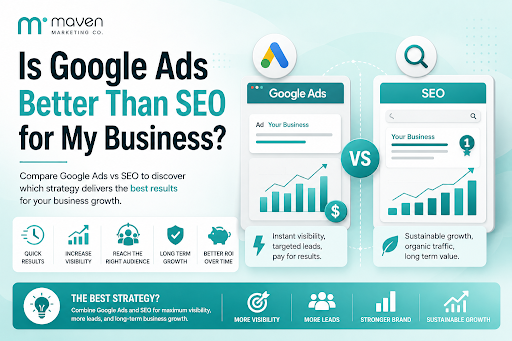
Is Google Ads Better Than SEO for My Business
One of the biggest questions business owners ask when they are planning online growth is whether they should invest in Google Ads or SEO. Both are strong marketing plays that help your company show up in Google search results, but they do things in separate lanes. Google Ads gives quicker visibility and can bring in leads fast, whereas SEO more or less focuses on slow, steady organic traffic that tends to grow the longer you keep building it. Picking the right direction depends on what you want to achieve, how much money you can spend, how crowded the market is, and how quickly you need results, like sooner rather than later. The good news is you don’t always have to choose one or the other; it’s not exactly a black-and-white situation. If you take time to understand the strongest points of both, you can put together a more sensible digital marketing plan that supports consistent expansion. In this guide, we’ll compare Google Ads vs SEO, explain the main differences, and help you figure out what option makes the most sense for your business.

When Should I Hire a Digital Marketing Agency
Growing a business today takes more than just having a website or throwing a post on social media; customers usually search around online, compare providers, skim reviews, and basically expect the brand to show up with a solid digital presence before they even think about buying. Many businesses try to run their marketing themselves, but there comes a point when “doing it all in-house” becomes clunky and hard to manage, all at once. Knowing when to hire a digital marketing agency can end up making a big, real difference for your growth. If you’re not getting enough leads, or your online visibility feels stuck, or sales are just not moving, the right agency can bring the know-how, plus a clear plan, to help you get noticeably better outcomes. In this guide, we’ll dig into what a digital marketing agency actually does, the usual signs it’s time to bring one on, and how picking the right marketing partner can help your business move forward at a faster pace.
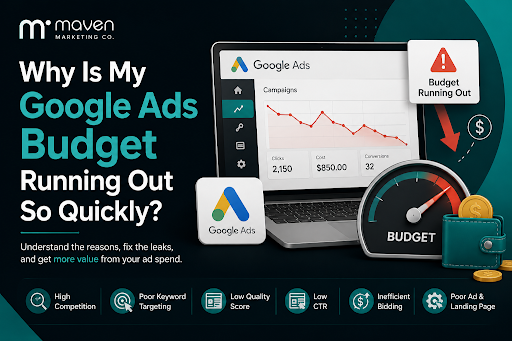
Why Is My Google Ads Budget Running Out So Quickly
Running a successful Google Ads budget isn’t only about throwing more money at it. It’s more like making every dollar, doing a bit extra. A lot of businesses start a Google Ads campaign with big hopes, then find out their daily budget is gone within a few hours, and that feels weird, right? After that, your ads stop showing effectively, new leads slip away, and your return on investment dips. So if your Google Ads budget is running out too fast, don’t stress. It’s a fairly common issue, and in most situations, it can be repaired with the right approach. There are multiple little things that can drain your advertising money quicker than you expected, from costly keywords to audience targeting that just doesn’t quite fit. In this guide, we’ll walk through why your budget disappears so quickly, how to cut wasteful spend, and the most reliable ways to boost your Google Ads ROI, even if your budget stays the same.