.svg)


%201.svg)
Key Takeaways
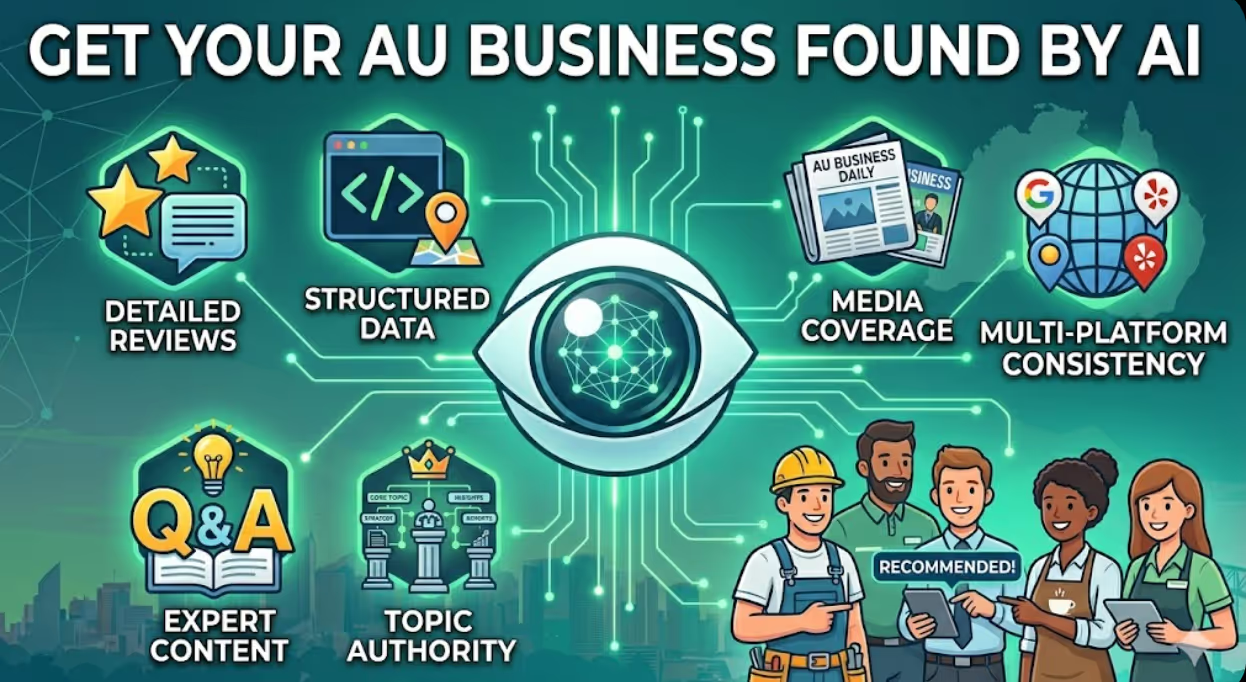
- AI tools including ChatGPT, Perplexity, Google AI Overviews, and Claude synthesise information from multiple sources to generate business recommendations. The businesses that appear in these recommendations are those with the strongest combination of credible mentions from third parties, structured information, content depth, and review presence.
- AI systems favour businesses with a strong, consistent information footprint across multiple sources: their own website, review platforms, industry directories, editorial coverage, and structured data. A business that exists only on its own website is largely invisible to AI discovery.
- Google's AI Overviews draw heavily from the same sources that influence organic search rankings, meaning that strong traditional SEO is a foundation for AI visibility, but additional signals specific to AI systems are also required.
- Review volume, review recency, and the language used in reviews directly influence how AI systems describe and recommend businesses. AI tools synthesise review content when generating responses, making the specific words customers use in reviews part of the recommendation language.
- Structured data markup on a website helps AI systems accurately identify and extract information about a business, including its name, location, service area, operating hours, and specialisations. Businesses without structured data require AI systems to infer this information from unstructured content, which produces inaccuracies.
- Content that directly answers the specific questions AI tools are asked about a category positions the business as the source AI systems draw from when generating responses. Comprehensive, factually specific content is significantly more likely to be cited or drawn upon than thin or generic content.
- AI visibility is an investment that pays off over the medium term with a compounding return. The credibility and information signals that AI systems use to assess a business take time to build but, once established, create a structural advantage that is difficult for competitors to replicate quickly.
How AI Tools Discover and Recommend Businesses
Understanding why most Australian businesses are invisible to AI requires understanding how AI discovery actually works. It is not a single, uniform process. ChatGPT with web browsing, Perplexity, Google AI Overviews, and Claude with web access each operate somewhat differently, but they share common underlying mechanisms for identifying and evaluating businesses to include in a recommendation.
Training data and knowledge. Large language models are trained on text from the web, including business directories, review sites, industry publications, news coverage, and general web content. Businesses that were covered extensively in the training data sources, that had strong review presence on major platforms, and that appeared in authoritative industry publications are embedded in the model's knowledge as credible, identifiable entities in their category.
Real-time web retrieval. AI tools with web access retrieve current information from the web at the time of the query. Perplexity and ChatGPT with web browsing actively search for current sources to supplement their trained knowledge. Google AI Overviews draws from Google's index. The businesses retrieved in these web searches are those with the same signals that drive strong organic search visibility: relevant, authoritative, structured content on their own site and across credible external sources.
Structured entity recognition. AI systems are increasingly good at identifying businesses as named entities with specific attributes: category, location, service area, specialisation, and associated characteristics. Businesses with consistent, structured information across multiple platforms are more reliably identified and correctly characterised by AI systems than those with fragmented or inconsistent information.
Citation and source authority. When an AI tool cites a source or draws information from a specific website, the authority of that source influences how the information is weighted. A business mentioned in a review on a major platform, covered in an industry publication, or listed in a government-associated business directory carries more weight than a business that only mentions itself on its own website.
Why Most Australian Businesses Are Invisible
The gap between a business's Google visibility and its AI visibility is most pronounced in the following scenarios.
The business exists primarily as a local presence without a significant editorial footprint. A plumber, an accountant, a cleaning service, or a retail shop with a functional website and a Google Business Profile is visible in local Google searches because local search prioritises proximity and Business Profile signals. But AI tools, particularly when asked for recommendations in a category without specifying a specific suburb, draw on a broader range of credibility signals that local businesses often have not developed: mentions in editorial content, reviews on multiple platforms, coverage in publications relevant to the industry, and a content library that demonstrates expertise.
The business has never been mentioned by a source the AI treats as credible. AI systems weight sources differently. A business mentioned in a local newspaper article, covered by an industry association, listed on a government procurement platform, reviewed on Trustpilot or Google with a substantial volume of detailed reviews, or cited in a practical guide on a major information site carries significantly more AI visibility than a business that only has content on its own site and a handful of Google reviews.
The business's content is generic rather than specific. AI tools generating responses to specific questions look for content that directly answers those questions. A website that describes services in generic terms ("we provide quality accounting services") provides less useful content for an AI system generating a response to "what accounting services does a small Australian ecommerce business need?" than a website with specific, detailed content that addresses that question directly.
The business has inconsistent or incomplete information across platforms. AI systems that encounter conflicting information about a business (different addresses on different platforms, inconsistent trading names, outdated contact details) lower their confidence in the business as a reliable recommendation. Consistency and completeness of information across all platforms where the business is listed is a foundational AI visibility requirement.
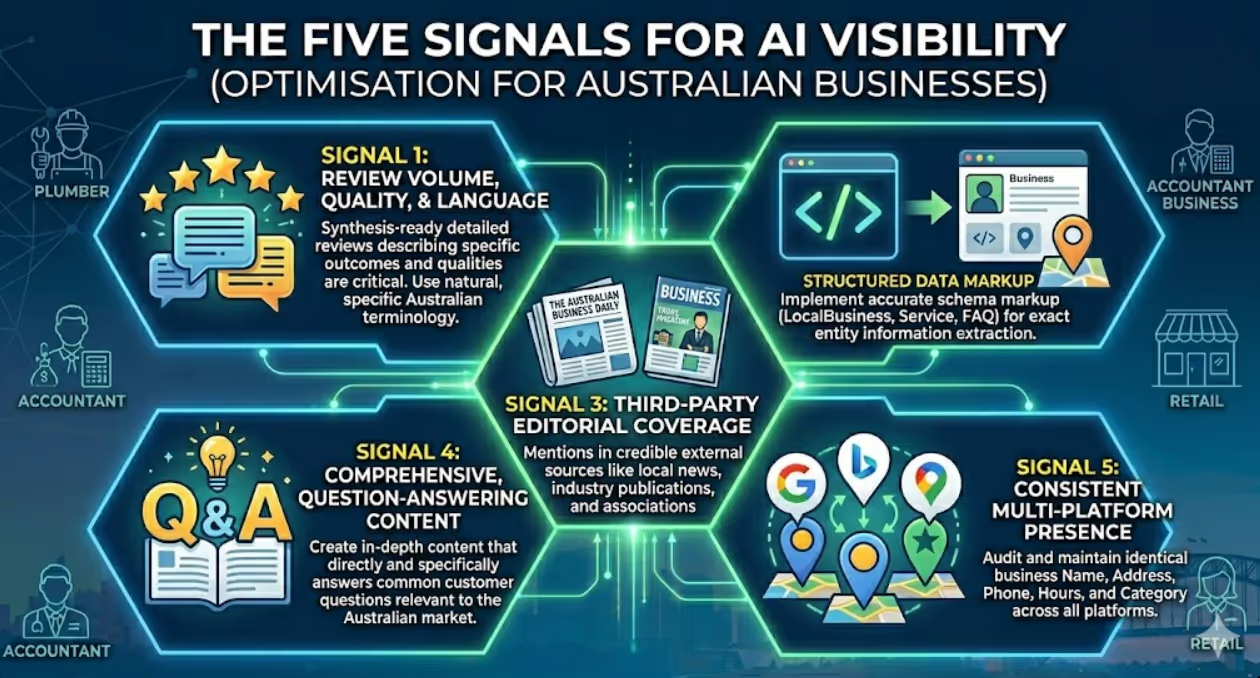
The Five Signals That Determine AI Visibility
Signal 1: Review Volume, Quality, and Language
Reviews are not just a trust signal for human readers. They are a data source that AI systems actively synthesise when generating descriptions and recommendations. An AI tool asked to describe the best builders in a specific Australian city is drawing on the content of reviews as well as their quantity and score. The specific language reviewers use, the specific qualities they praise, and the specific outcomes they describe become part of how the AI characterises the business.
The practical implication is that the content of reviews matters as much as the volume and rating. Reviews that describe specific, relevant, and credible outcomes are more useful to AI systems generating recommendations than generic reviews awarded five stars with no substantive content.
Action: Actively invite satisfied customers to leave detailed, specific reviews on Google, Trustpilot, and any platform relevant to the industry. Provide review guidance that encourages descriptions of specific outcomes, use cases, and qualities rather than generic praise. Aim for a minimum of 50 reviews on Google with a mix of detailed and brief content.
Signal 2: Structured Data Markup
Structured data on the business website tells AI systems and search engines precisely what the business is, where it is, what it does, and how to reach it. The most important schema types for Australian business AI visibility are LocalBusiness (or a more specific subtype), Service, FAQ, HowTo, and Product where applicable.
A LocalBusiness schema block that specifies the business name, address, geographic coordinates, service area, opening hours, phone number, category, and a description written to match common query language gives AI systems a reliable and precisely structured source of accurate information about the business.
Action: Implement or audit LocalBusiness structured data on the website's homepage and key landing pages. Ensure the schema is accurate and current, including service area, operating hours, and specialisations. Validate the implementation using Google's Rich Results Test tool.
Signal 3: Third-Party Editorial Coverage
Being mentioned in external, editorially credible sources is one of the strongest AI visibility signals available. This includes mentions in local or industry news publications, coverage in industry association newsletters or publications, guest articles or expert commentary in relevant online publications, and listings in reputable curated directories.
Australian business owners who contribute to industry publications, provide expert comment to journalists, write for trade media, or participate in industry associations are building the external editorial footprint that AI systems treat as a credibility indicator.
Action: Identify three to five credible publications, directories, or industry platforms in the relevant category and pursue editorial presence. This might mean pitching expert commentary to a trade publication, applying for accreditation listing on an industry association directory, or contributing a practical instructional article to a relevant industry blog. Even a single credible external mention from the right source improves AI visibility meaningfully.
Signal 4: Comprehensive, Question-Answering Content
The content that appears most often in AI-generated responses is content that directly and comprehensively answers the specific questions those AI tools are being asked. A website with a knowledge base, blog, or FAQ section that addresses the real questions people in the target category ask is far more likely to be drawn upon by an AI system than a website with only service pages and an About section.
Action: Identify the ten to twenty most common questions people ask about the category the business operates in, using tools like Google's People Also Ask, Answer The Public, or simply noting the questions that come up in sales conversations and customer interactions. Create content that answers each of these questions directly, specifically, and with enough depth to be genuinely useful rather than superficial. This content positions the website as an authoritative source that AI systems draw from when generating responses.
Signal 5: Consistent Multi-Platform Presence
AI systems assess business credibility partly through corroboration: a business that appears consistently across multiple credible platforms, with consistent name, address, phone number, and category information, is treated as a more reliably identified entity than one that exists only on its own website.
Action: Audit the business's presence across Google Business Profile, Bing Places, Apple Maps, Trustpilot, Yellow Pages, True Local, and any industry-specific directories. Ensure that the business name, address, phone number, operating hours, and category are identical across every platform. Remove or merge duplicate listings. Complete every field on every platform, including the description, categories, and service areas.
AI Overviews: The Google-Specific Opportunity
Google's AI Overviews are now appearing at the top of search results for a growing range of queries in Australia. Unlike the organic results below them, AI Overviews are generated responses that synthesise information from multiple indexed sources. The businesses and sources cited in AI Overviews are those with the strongest combination of traditional SEO signals and AI-specific content quality signals.
The practical approach for appearing in Google AI Overviews mirrors the broader AI visibility programme but with a specific emphasis on:
Structured data that is correct and comprehensive. Clear, factual content that directly answers the search query. High authority inbound links from credible sources. Strong review presence and ratings. FAQ content that matches the conversational query structure that AI Overviews are typically triggered by.
Monitoring which queries trigger AI Overviews in the business's category, and ensuring the website has specific, content of high quality addressing those queries, is the most targeted approach to Google AI Overview visibility.
FAQs
How can an Australian business tell whether it currently appears in AI-generated recommendations?The most direct method is to query the AI tools most used by the target audience with the questions those customers are likely to ask. For a Melbourne-based commercial electrician, this means asking ChatGPT, Perplexity, and Google's AI Overview "best commercial electricians in Melbourne," "who are the most recommended commercial electrical contractors in Melbourne," and "commercial electrical services Melbourne review." Record which businesses appear in responses across multiple queries and on multiple days, since AI responses can vary. If the business does not appear, the gap analysis involves assessing which of the five signals described in this article are weakest for the business relative to those that do appear. A business that consistently appears in organic search results but not in AI responses typically has an editorial footprint gap or a structured data deficiency rather than a content quality problem.
Will investing in AI visibility harm the business's traditional SEO, or are they complementary programmes?The signals that drive AI visibility and traditional SEO are substantially complementary rather than competing. Content of high quality that answers specific questions is valued by both Google's search algorithm and AI systems. Structured data improves both organic search appearance and AI entity recognition. Editorial coverage from third parties produces backlinks that benefit SEO and credibility signals that benefit AI visibility. Review volume and quality is a positive signal for both local search rankings and AI recommendation inclusion. The main investment that is more specific to AI visibility than to traditional SEO is the audit of presence across multiple platforms and the editorial footprint development, which produce AI visibility benefits that SEO alone does not. Australian businesses that treat AI visibility as an extension of their existing SEO programme rather than a separate initiative will find significant overlap in the required work and a compounding return from investments that benefit both channels simultaneously.
How long does it take for AI visibility improvements to produce measurable results for an Australian business?AI visibility improvements operate on two timelines. Improvements to structured data, Google Business Profile completeness, and consistency across multiple platforms can produce measurable changes to AI Overview inclusion and AI responses indexed by Google within four to twelve weeks, as Googlebot crawls and indexes the changes and the AI Overview system incorporates updated information. Improvements to review volume, editorial coverage, and content depth operate on a longer timeline of three to twelve months, because these signals require sustained activity over time to accumulate the volume and diversity that AI systems treat as reliable credibility indicators. A business that implements the full programme described in this article comprehensively and consistently should expect meaningful AI visibility improvements within six to twelve months, with the strongest results appearing in the twelve to eighteen month window as the compounding effect of multiple simultaneous improvements becomes apparent.
Invisible to AI Is Invisible to an Increasingly Large Part of Your Market
The proportion of Australian consumer and B2B purchase journeys that begin with an AI query is growing. It is not yet the dominant discovery channel for most categories, but its growth trajectory is clear and its commercial impact on the businesses that appear in AI recommendations versus those that do not will compound over the next two to three years in the same way that the commercial impact of Google rankings compounded between 2005 and 2015. The businesses that build their AI visibility now, through the content, reviews, structured data, and editorial presence that AI systems use to identify and recommend them, will hold a structural advantage when discovery mediated by AI reaches the scale that makes the channel undeniable. Waiting until then to begin is waiting until the competitive positions are already established.
Maven Marketing Co develops AI visibility strategies for Australian businesses, including structured data implementation, review acquisition programmes, editorial coverage development, and content strategies designed to appear in AI-generated recommendations.
Talk to the team at Maven Marketing Co →

Table of contents
read more blogs
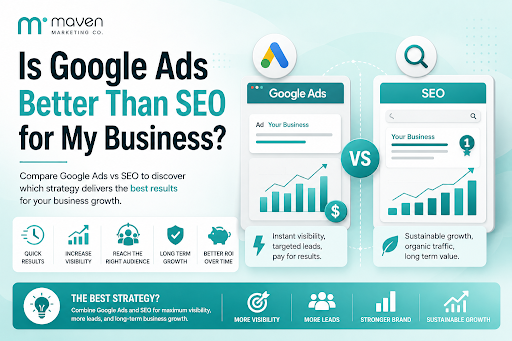
Is Google Ads Better Than SEO for My Business
One of the biggest questions business owners ask when they are planning online growth is whether they should invest in Google Ads or SEO. Both are strong marketing plays that help your company show up in Google search results, but they do things in separate lanes. Google Ads gives quicker visibility and can bring in leads fast, whereas SEO more or less focuses on slow, steady organic traffic that tends to grow the longer you keep building it. Picking the right direction depends on what you want to achieve, how much money you can spend, how crowded the market is, and how quickly you need results, like sooner rather than later. The good news is you don’t always have to choose one or the other; it’s not exactly a black-and-white situation. If you take time to understand the strongest points of both, you can put together a more sensible digital marketing plan that supports consistent expansion. In this guide, we’ll compare Google Ads vs SEO, explain the main differences, and help you figure out what option makes the most sense for your business.

When Should I Hire a Digital Marketing Agency
Growing a business today takes more than just having a website or throwing a post on social media; customers usually search around online, compare providers, skim reviews, and basically expect the brand to show up with a solid digital presence before they even think about buying. Many businesses try to run their marketing themselves, but there comes a point when “doing it all in-house” becomes clunky and hard to manage, all at once. Knowing when to hire a digital marketing agency can end up making a big, real difference for your growth. If you’re not getting enough leads, or your online visibility feels stuck, or sales are just not moving, the right agency can bring the know-how, plus a clear plan, to help you get noticeably better outcomes. In this guide, we’ll dig into what a digital marketing agency actually does, the usual signs it’s time to bring one on, and how picking the right marketing partner can help your business move forward at a faster pace.
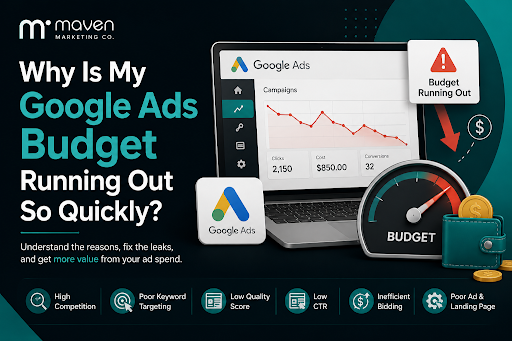
Why Is My Google Ads Budget Running Out So Quickly
Running a successful Google Ads budget isn’t only about throwing more money at it. It’s more like making every dollar, doing a bit extra. A lot of businesses start a Google Ads campaign with big hopes, then find out their daily budget is gone within a few hours, and that feels weird, right? After that, your ads stop showing effectively, new leads slip away, and your return on investment dips. So if your Google Ads budget is running out too fast, don’t stress. It’s a fairly common issue, and in most situations, it can be repaired with the right approach. There are multiple little things that can drain your advertising money quicker than you expected, from costly keywords to audience targeting that just doesn’t quite fit. In this guide, we’ll walk through why your budget disappears so quickly, how to cut wasteful spend, and the most reliable ways to boost your Google Ads ROI, even if your budget stays the same.