.svg)


%201.svg)

Key Takeaways
- Speed dictates consumer behaviour: Every additional second of load time actively destroys conversion rates. Immediate visual feedback is non-negotiable for establishing brand trust and keeping users engaged.
- Proximity is power: Cloudflare’s global network bridges the geographical divide by caching your website’s assets on edge servers physically closer to your visitors, drastically reducing data transit times.
- Core Web Vitals are mandatory: Google’s search algorithms and modern AI Overviews heavily prioritise websites that excel in loading performance (LCP), interactivity (INP), and visual stability (CLS).
- Default settings are insufficient: Merely routing your domain through a CDN does not guarantee optimal performance. Brands must actively configure minification, advanced image compression, and smart routing protocols.
- Security must balance with speed: Overzealous firewall settings and aggressive bot protection can inadvertently inject render-blocking scripts, punishing genuine users with slower load times.
There is a silent, invisible assassin systematically destroying your marketing budget, and it does not leave a trace in your Google Ads dashboard. It happens in the microscopic gap between a user clicking your link and your website appearing on their screen. In the modern digital landscape, patience is an entirely depleted resource. When a consumer clicks a link, they expect instantaneous gratification. If they are met with a stuttering loading bar or a blank white screen, a visceral psychological reaction occurs. Frustration sets in, trust evaporates, and within mere seconds, they will hit the 'back' button to find a competitor who respects their time.
For a long time, marketing directors have treated website hosting and server performance as purely an IT problem. This is a fatal miscalculation. Website speed is a fundamental marketing issue. It is the very first interaction a potential customer has with your brand. If your digital storefront struggles to open its doors, no amount of persuasive copywriting or aggressive discounting will save the sale. This is where the strategic implementation of a Content Delivery Network—specifically, mastering Cloudflare optimisation—transitions from a technical chore to your most potent competitive advantage.
Bridging the Geographical Divide
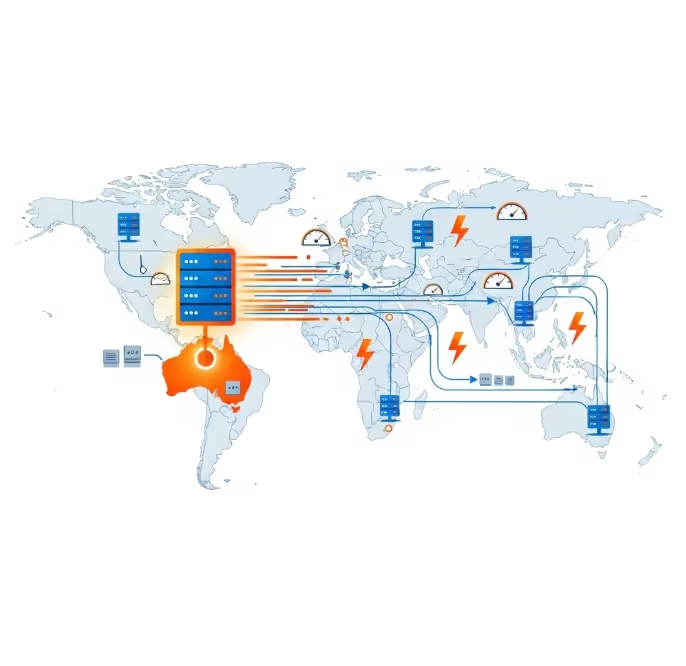
To understand why a CDN is critical, particularly for Australian businesses, we must confront the physical limitations of the internet. Data is not magic; it consists of electrical impulses and pulses of light travelling through submarine cables. If your website is hosted on a server in Sydney, and a potential client attempts to access it from Perth—or London, or New York—that data must physically travel thousands of kilometres. It must navigate through numerous routers and exchange points, accumulating micro-delays at every stop. This phenomenon is known as latency.
Cloudflare fundamentally alters this architecture. Rather than forcing every single visitor to request data from your single origin server, Cloudflare operates a massive global network of edge servers. When you implement this infrastructure, you are effectively placing a cached, perfectly preserved copy of your website in hundreds of cities around the world. As experts explain regarding the mechanics of content delivery networks, this system intercepts the user's request and serves the website from the physical location closest to them.
The psychological impact of this cannot be overstated. By reducing the physical distance the data must travel, you eliminate the visual stutter that causes users to abandon their journey. The website feels responsive, professional, and authoritative. You are no longer asking the consumer to wait; you are meeting them exactly where they are, instantly.
The AI Search Revolution and Core Web Vitals
Beyond the immediate psychological benefits of a lightning-fast user experience, there is a profound SEO imperative for aggressive speed optimisation. Search engines are undergoing a radical evolution. The traditional ten blue links are being replaced or augmented by AI Overviews and highly complex ranking algorithms that prioritise human-centric metrics over traditional keyword stuffing.
Google’s framework for measuring this user experience is known as understanding Core Web Vitals. This rigorous set of metrics evaluates exactly how a user perceives your site's performance. It scrutinises the Largest Contentful Paint (LCP), which measures how quickly your main hero image or text block appears. It measures Interaction to Next Paint (INP), ensuring buttons and links respond the millisecond they are clicked. Finally, it tracks Cumulative Layout Shift (CLS), penalising sites where text jumps around as images load late.
If your website fails these metrics, you are actively suppressed in search results. Furthermore, Large Language Models (LLMs) parsing the web for AI summaries are designed to extract information from highly authoritative, technically sound sources. A slow, unresponsive website signals poor quality to both human users and artificial intelligence. Cloudflare provides the exact toolkit required to manipulate and master these specific metrics, ensuring your brand remains highly visible in the AI-driven future of search.

The Configuration Blueprint: Moving Beyond Default Settings
A common and costly mistake made by many businesses is assuming that simply activating a free Cloudflare account will instantly solve their performance woes. Cloudflare is a staggeringly powerful engine, but like any high-performance vehicle, it requires precise tuning to achieve maximum velocity. Relying on the default settings leaves an immense amount of potential on the table.
The first crucial configuration step involves tackling code bloat. Modern websites are heavy. They are weighed down by thousands of lines of HTML, Cascading Style Sheets (CSS), and complex JavaScript required to run tracking pixels and interactive elements. Cloudflare’s Auto Minify feature acts as a ruthless editor. It automatically strips out every unnecessary space, comment, and line break in your source code before it reaches the user. To the human eye, the code becomes unreadable, but to a web browser, it becomes a streamlined package that can be downloaded and executed in a fraction of the time.
However, code is rarely the primary culprit behind sluggish load times. The most significant drag on your website’s performance is almost certainly your visual assets. High-resolution product photography and full-width banner images are essential for modern web design, but they are incredibly heavy files.
This is where Cloudflare’s image optimisation capabilities, specifically the 'Polish' feature available on paid tiers, become invaluable. Rather than relying on your marketing team to manually compress every image uploaded to the CMS, Cloudflare automates the process on the fly. It strips unnecessary metadata and, crucially, can automatically serve modern image formats like WebP and AVIF to compatible browsers. These next-generation formats maintain the exact visual fidelity of a traditional JPEG but at a fraction of the file size. When your largest visual elements load fifty per cent faster, your LCP scores plummet, directly satisfying Google’s most stringent speed requirements.
Caching Rules and the Edge TTL Strategy
To truly master Cloudflare, you must understand how to command its caching behaviour. By default, Cloudflare is conservative. It will cache static assets like images and stylesheets, but it will bypass the cache for HTML to ensure users do not see outdated content. For content-heavy websites or e-commerce catalogues that do not change by the minute, this is a missed opportunity.
Through the implementation of Page Rules, or the newer Cache Rules interface, you can dictate exactly how long specific assets should live on Cloudflare's edge servers. Setting an aggressive Edge Cache TTL (Time to Live) for your blog posts, product pages, and promotional landing pages means that Cloudflare rarely has to bother your origin server at all. When a user requests the page, the edge server delivers it immediately from memory. This not only drastically accelerates the load time but also significantly reduces the bandwidth and processing burden on your primary hosting environment, potentially saving you substantial infrastructure costs.

The Double-Edged Sword of Bot Protection
In the pursuit of raw speed, we must also address the delicate balance between performance and security. Cloudflare is just as famous for its robust Web Application Firewall (WAF) and DDoS protection as it is for its CDN capabilities. However, security features inherently introduce friction.
One of the most common configuration errors that devastates Core Web Vitals is the overzealous application of Bot Fight Mode. While it is crucial to protect your site from malicious scrapers and spam, aggressive bot protection often forces Cloudflare to inject a hidden JavaScript challenge into the browser to verify the user is human. This invisible script halts the rendering of the page until the verification is complete.
For genuine human users, this manifests as an inexplicable delay. Your server response time might be blazing fast, but the user is left staring at a blank screen while the browser solves a background math problem. If you are struggling to pass your First Input Delay or Interaction to Next Paint metrics, you must audit your security settings. Security should be surgical, not a blunt instrument that punishes your actual customers. Utilise targeted WAF rules and rate limiting instead of blanket bot challenges that degrade the overall user experience.
Case Studies in Performance Acceleration
The theory of website speed is compelling, but the commercial reality is undeniable. When brands commit to comprehensive technical optimisation, the financial returns are consistently staggering. We do not optimise for speed simply to appease search engine algorithms; we optimise to drive revenue.
The E-commerce Conversion Leap: Pacsun
Consider the retail sector, where the correlation between milliseconds and profit margins is absolute. Pacsun, a major apparel retailer, faced the dual challenge of ensuring complete uptime during massive seasonal traffic spikes while simultaneously improving their baseline user experience. They were losing potential buyers at the critical checkout phase due to sluggish dynamic content loading.
By moving their infrastructure behind Cloudflare and leveraging enterprise-level load balancing and advanced caching protocols, the results were immediate. They witnessed an overnight improvement in performance, with systems running 27 per cent faster. Their cache hit rates surged, meaning more users were served data instantly from edge servers rather than waiting for the central database to respond. This reduction in friction directly correlated with a more seamless shopping experience, allowing users to transition from browsing to purchasing without the hesitation induced by a loading spinner.
The B2B Traffic Surge: Mobify
In the B2B space, where the sales cycle is longer and the required reading is heavier, load time dictates whether a prospect will consume your thought leadership or bounce back to the search results. Mobify, a mobile shopping platform, meticulously analysed their conversion funnels and discovered a direct leak tied to performance.
They embarked on a rigorous optimisation campaign, focusing heavily on asset minification and reducing the Time to First Byte (TTFB). The data they uncovered remains one of the most cited statistics in performance marketing: a mere 100-millisecond decrease in their homepage load time resulted in a 1.11 per cent increase in session-based conversions. When you extrapolate a one per cent conversion lift across hundreds of thousands of annual visitors, the ROI of investing in technical SEO and CDN configuration completely dwarfs traditional advertising expenditures.
Securing Your Brand’s High-Speed Future
The digital marketplace is entirely devoid of friction. If your website is slow, you are actively choosing to place an obstacle between your customer and your product. Consumers have been conditioned by the world's largest tech platforms to expect instant, seamless interactions. They will not extend grace to a brand that forces them to wait.
Configuring a CDN like Cloudflare is not a task you can set and forget. It is an ongoing strategic process of monitoring real-user metrics, adjusting caching rules, experimenting with new image formats, and carefully balancing ironclad security with frictionless delivery. When executed correctly, it transforms your website from a passive digital brochure into a highly tuned, aggressive conversion engine that dominates search rankings and commands consumer trust.
Stop allowing unoptimised code and geographical latency to steal your conversions. If you are ready to stop bleeding revenue to slow load times and want to engineer a digital experience that converts, partner with Maven Marketing Co. today. Our technical SEO experts will implement a bespoke Cloudflare strategy designed to slash your latency, conquer Core Web Vitals, and accelerate your brand's growth.
Frequently Asked Questions
Will using Cloudflare break my website's dynamic features?
When configured correctly, no. Cloudflare is highly customisable. While it caches static assets (like images and text) by default, it knows to bypass the cache for dynamic events like shopping carts, user logins, and administrative dashboards. Through careful use of Page Rules, you can ensure that fast delivery never interferes with complex website functionality.
Is the free version of Cloudflare enough to improve my SEO?
The free tier provides exceptional value, offering global CDN distribution, basic minification, and robust DNS resolution that will noticeably improve your Time to First Byte (TTFB). However, for highly competitive industries where Core Web Vitals are a major ranking factor, the paid tiers are highly recommended. They unlock crucial automated features like 'Polish' for advanced WebP image compression and 'Argo Smart Routing' to navigate around internet congestion.
How quickly will I see SEO improvements after configuring a CDN?
You will see the improvement in your physical load times immediately upon the DNS propagating. However, SEO is a lagging indicator. It typically takes a few weeks for Google to recrawl your entire site, process the improved Core Web Vitals data from real users (field data), and adjust your organic rankings accordingly. Speed is a foundational investment that pays compounding dividends over time.

Table of contents
read more blogs

How to Build a Customer Journey Map for Your Digital Marketing Strategy
A strong digital marketing strategy is not just about channels, creative or traffic. It is about understanding how real people move from first awareness through to enquiry, purchase and ongoing loyalty. That is exactly why customer journey mapping matters.Without a clear view of the journey, businesses often optimise in fragments. They improve the website without thinking about the ad that drove the visit, produce content without considering where the audience is in the decision process, or judge conversion performance without understanding the friction points that sit earlier in the experience.A customer journey map helps you step back and see the bigger picture. It shows the stages people move through, the touchpoints they interact with, the questions they ask, the barriers they face and the moments where your marketing can either help or lose them.This guide explains how to build a practical customer journey map for your digital marketing strategy, what information to include, how to use the map to improve performance and which common mistakes to avoid. The goal is not to create a pretty workshop artefact that gets forgotten. It is to build a working tool that improves messaging, user experience, channel decisions and conversion outcomes.

Why Your Google Ads Campaign Is Not Getting Results: Common Mistakes and Solutions
If your Google Ads campaign is getting impressions or clicks but not producing enough enquiries, sales, or qualified leads, the problem is usually not Google Ads itself. It is more often a strategy, tracking, or conversion issue somewhere in the system.That matters because paid search can look busy without being commercially effective. You can have traffic coming in, a reasonable click-through rate and money leaving the account every day, yet still have very little to show for it if your keywords are weak, your ad copy is misaligned, your landing pages do not convert or your tracking is incomplete.A strong campaign works as one connected chain. Search intent, keyword targeting, ad relevance, bidding, landing-page experience, and conversion tracking all need to support the same commercial outcome. If one link breaks, results usually suffer quickly.This guide explains the most common reasons a Google Ads campaign is not getting results, what those issues normally look like in practice and how to fix them without relying on guesswork. The focus is not on vanity metrics. It is on improving lead quality, conversion rate, and return on spend.

6 Ways Digital Marketing Can Boost B2B Lead Generation
B2B lead generation is not about filling a CRM with as many names as possible. The real objective is to attract businesses that fit your offer, give the right people a reason to engage and create enough confidence for a genuine sales conversation to start.That distinction matters because B2B buying is usually more targeted than consumer marketing and often involves several people influencing the decision. Current LinkedIn lead-generation guidance makes the same point: more leads do not automatically mean better results if only a small proportion are genuinely relevant or likely to progress.Digital marketing helps by creating multiple paths into the business. Search can capture active demand. Paid media can put an offer in front of a tightly defined audience. Content can build authority before a buyer is ready to talk. Social media can keep the brand visible across a long decision cycle. Your website turns interest into action, while email helps nurture that interest over time.The strongest B2B digital marketing strategies do not treat these as six separate activities. They use them as one connected system designed to generate quality B2B leads, support sales and build a more dependable pipeline